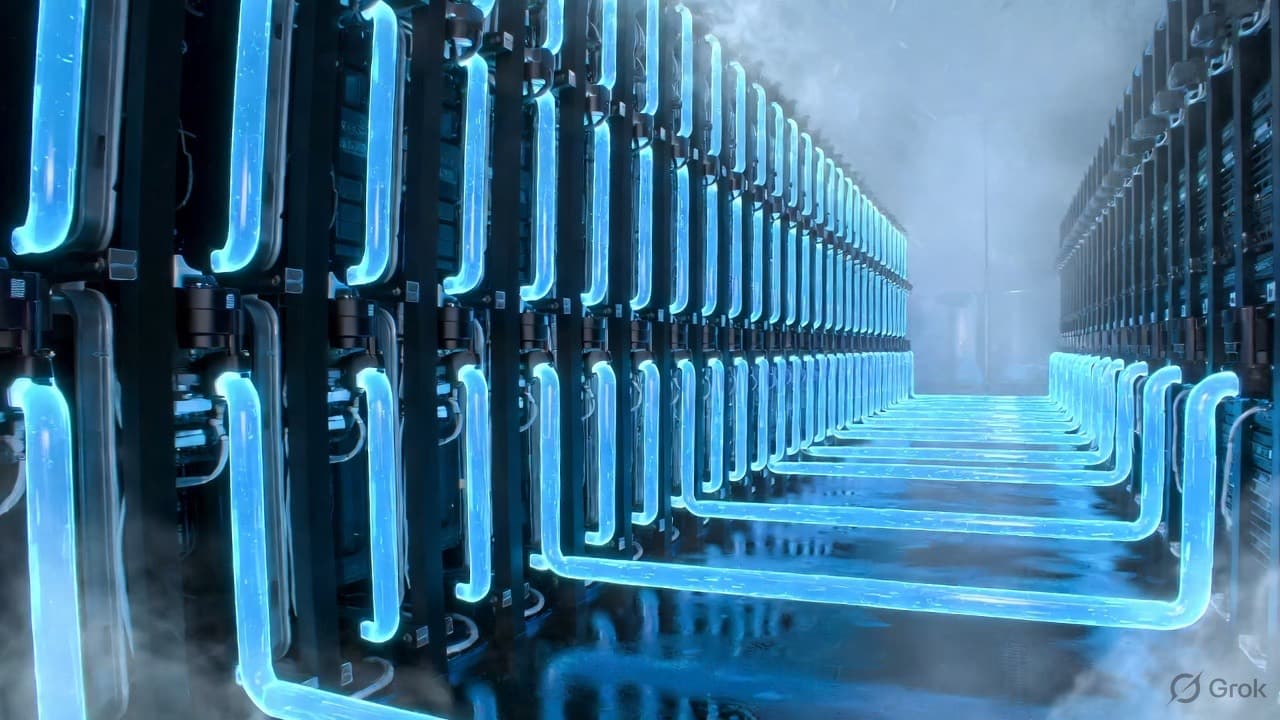
AI server racks now draw so much power, often tens of kilowatts and in next-generation designs reportedly hundreds, that air can no longer carry the heat away, so liquid cooling is becoming the default for new AI data centres. Most new builds use direct-to-chip cooling, with cold plates sitting on the processors, while some use full immersion. And the biggest AI campuses are now planned in gigawatts of power, not megawatts.
The three main approaches
- Direct-to-chip: liquid flows through cold plates mounted on CPUs and GPUs. It's the most common approach in new AI deployments.
- Immersion: whole servers sit in a non-conductive fluid. It's very efficient, but needs different hardware and operations.
- Rear-door heat exchangers: liquid-cooled doors on racks. A bridge for older data centres.
How fast is adoption?
Estimates vary a lot between sources, from about a third to over 40% of new AI data-centre capacity using liquid cooling in 2026, with some hyperscaler projects mandating it outright. The direction is clear even if the exact number isn't: air cooling can't keep up with modern AI hardware.
Why gigawatts?
A large AI campus can now need as much power as a city. That's why data-centre siting increasingly depends on power and water availability, and why long equipment lead times (for transformers especially) have become a bottleneck.
Why it matters to everyone building with AI
- Cooling and power, not just chips, limit AI capacity. That affects how quickly AI prices fall.
- Efficiency matters. Better cooling means more compute per unit of energy, which shows up eventually as cheaper inference.
- Location matters. Countries with power, water and cooler climates, and increasingly India with its data-centre boom, attract AI infrastructure.
Efficient software, efficient infrastructure
At NextGen Fusion, our software development company in Lucknow, we build lean applications and right-size AI usage, because the cheapest compute is the compute you don't need.