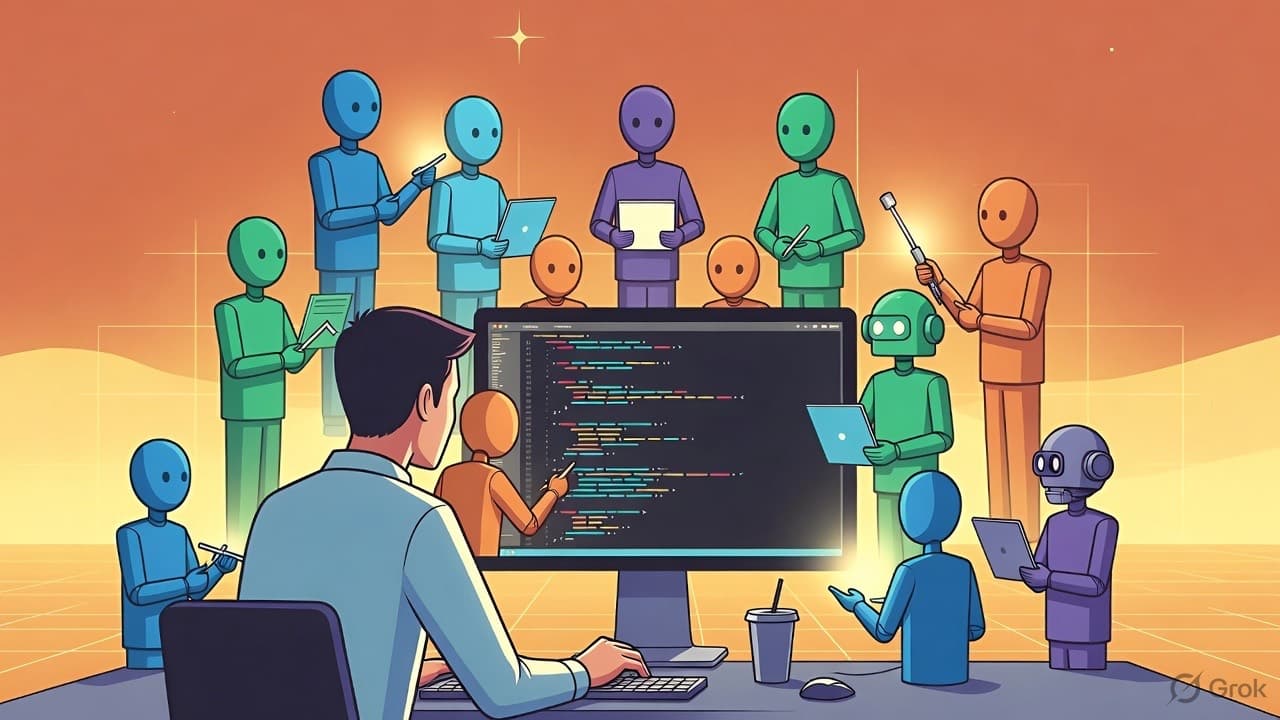
The "one-person product team", meaning a single developer who designs, builds, ships and runs a real product with AI doing much of the typing, has quietly become one of the defining trends of 2026. AI coding agents can now take whole tasks and come back with a pull request, and the same tools help with design, copy, testing and support. What used to need four or five people can, for a well-scoped product, be done by one person who knows what they're doing.
What's actually changed
- Code: agents write features, tests and migrations from a clear specification.
- Design: AI tools generate UI drafts and assets that a developer can refine.
- Content: product copy, docs and marketing drafts in minutes.
- Operations: AI support assistants handle first-line customer questions.
What hasn't changed
- Judgement: deciding what to build, what to skip, and when "good enough" is good enough.
- Architecture: AI accelerates whatever direction you choose, including the wrong one.
- Accountability: someone has to review every change, own security, and answer when something breaks at 2 a.m.
- Domain knowledge: understanding the customer's problem is still the hardest part.
The skill that matters most is no longer typing speed. It's specifying clearly, reviewing critically and verifying with tests.
How to work as a one-person team, well
- Keep scope tight. One core workflow, done excellently.
- Invest in tests and CI early. They're your second reviewer.
- Use boring, proven tech like Next.js, PostgreSQL and managed hosting, so AI tools know it well and you're not debugging novelty.
- Automate deployment and monitoring from day one.
- Write things down: project instructions for your AI tools double as documentation.
My experience
This is how a growing share of client work gets done: a small, experienced, AI-assisted team delivering what clients assume needs a much larger one. Through NextGen Fusion, my web and software development company in Lucknow, I can bring in more people when a project needs them, but a lot of products don't.